Donnerstag, 29. März 2007

HRVATSKA=CROATIA – HOW DID IT COME TO THIS WORD?


Croatian history seems somehow to be shrouded in mystery, despite strenuous efforts of the historians to find out with pinpoint accuracy which part of the globe our ancestors resided. No one seems too sure as to whether it was here or there down to the migrations. While one is of the opinion that we are from Iran, the others claim something else. According to Ferdo Siscic, one of the greatest Croatian historians, Croatians may really have its roots somewhere in the Caucasus, as does the word Hrvatska (pronounced /hrvacka/). The word Horovathos is traced on two stone inscriptions in Greek language and script (year 200 a.d.) found by the Black sea. What is interesting is that the name Chrowat (= Croat) appears in the region of northern Steiermark. There is a place called Kraubat to which the word Chrowat relates. What is more, in Corinthian there is a place called Kraut, which name is also derived from the Middle Age name Chrowat. If you want to find more, have a look at http://www.croatianhistory.net/etf/et01.html#buga.
Next time I could explain the symbols on our flag. Isn’t it a great idea?
Have fun!

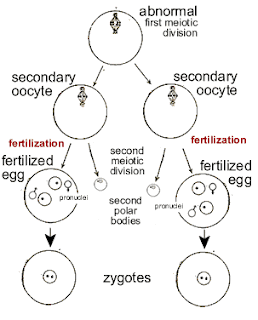
The world's only known case of "semi-identical" twins

Read under: http://news.bbc.co.uk/2/hi/heaalth/6498215.stm
After reading the article, I was curious to find more information about the twins, since I wasn’t satisfied with the info provided. On the internet I found a kind of essay about twins. To be precise, about “What makes twins biologically and psychologically alike and what are the causes of any differences in a pair of twins?” I’ll sum it up briefly and if you want to read it yourself, follow the link:
http://serendip.brynmawr.edu/biology/b103/f00/web3/hayesconroya3.html


There are several types of twins:
  1. fraternal or dizygotic twins – if there are two eggs released and both fertilized. The twins can than be male-male, female-female or female-male

  2. identical or monozygotic – when a fertilized egg splits. The twins can then be either female-female or male-male. What struck me as fascinating is the phenomenon of so called mirror imaging. If the morula (the fertilized egg) splits between day 10-13, the twins can be mirror images of each other. One can be left-handed while the other right-handed or they can even have birthmarks on the same part of the body, the one on the left and the other on the right.
    Siamese twins (named after famous twins from Siam – joined at the breastbone) are also monozygotic and are the result of the “too late” splitting up (after day 13), which is why the division is not successful.

  3. other types.

Aren’t all these “phenomena” fascinating? I wanted to find more info about twins on a genetic level (from morula to fetus, from fetus to I don’t know what), but unfortunately I ran out of time. Maybe some other time. I’ll be back!!

I’ve found it! The theory of semi-identical twins:

A PEACEFUL BRITISH INVASION

An article in “Spotlight”

This article is about British people moving to Normandy, and so perfectly relates as well as to the topic covered this term as to the book I’m reading (“A year in Provence”). Families, who have spent their holidays in Normandy, fell under its spell and settled down actually in the middle of nowhere to make their wishes come true. Which wishes? To start a business from scratches since this couldn’t have been affordable (or maybe still isn’t) in Britain, inasmuch as the property market is up to five times as expensive. The trend towards heading down to France began 20 years ago.
What I found interesting is the remark that socialisation takes place not in pubs, as it is in Britain, but at people’s houses.

INTERESTING VOCAB:
- rat race – ständiger Konkurrenzkampf : to get out of the rat race

I have to say that I admire these people for summoning courage and above all for taking the plunge and go to leave somewhere else on our enticing blue globe. You might say that I did something similar, as I left Croatia, my home, to live/study abroad. Alike though it seems, it is by far not the same, since I left my country for the time being, except if I in the end marry a fetching Austrian guy and stay here.:) Be that as it may, what I want to say is that I cannot imagine living miles away from my place of birth. (Our house- the photo blow)
The story goes as it follows, since my brother and sister left the nest (they have their own family), the destiny of the house hinges somehow upon me. It is not that I crave to reside a village where neighbours green with envy don’t feel like talking to each other, but I cannot imagine putting the house up to sale. Moreover, I can’t live without my nephews. If it weren’t for these reasons, I would like to live in Africa. I’m talking rubbish!! I’m not at all like that. Well, maybe a bit.

JANUARY

This fabulous and hilarious book begins on New Year’s Day with a divine lunch in a restaurant in France. Peter Mayle and his wife have for long been considering to realize their long-cherished dream to move to Provence, where they spent their hot summer holidays. Finally, they bought a charming 200-year-old farmhouse at the base of the Lubéron Mountains, took French lessons and shipped their two dogs from UK.
The secluded and warm place planted with vines, as well as the hospitality of their neighbours (Henriette & Faustin) was enticing them more and more. Neither the unearthly dialect nor the stories about the bone-chilling winter wind Mistral, “which was blamed for every problem in Provence that couldn’t be blamed on the politicians”, couldn’t make them change their minds. They didn’t know that the stories about the wind were true till the day they experienced it firsthand. The wind cracked their pipes, ripped tiles from the roof and tore a window from its hinges.
I would love to experience the winters there in France. It might change my attitude towards winter, in particular the snow because up till now, regardless the aftermaths, I’ve been craving for it. A winter without snow is like a mouth without teeth :). It’s like the song says: Love and marriage go together like horse and carriage …” And all people just grumble and whinge and I don’t know what else. I like it and I want snow, right now!
“Let it snow, let it snow, let it snow!”


By the same token, do you know what I find peculiar here in Austria concerning winters? As soon the temperature drops not even below freezing, the heating immediately “gets into top gear” and it gets unbearably hot. Are the Austrians cold people? What is more, instead of “shifting into the first gear”, they /we open the windows, if at all. From my point of view a bit strange.
Besides the wind, bureaucratic mazes weren’t making their life easier. Buying the house was a disaster, let alone a car because “documents are holy things here and deserve respect”. We meet Antoine Massot, who is to become their “personal advisor”.
VOCAB
· Amiable – His parents seem very amiable
· Extenuating circumstances - There were extenuating circumstances and the defendant did not receive a prison sentence.
· Disposition – She has a cheerful disposition.
· Tiles – The wind ripped the tiles from the roof.

In comparison to JI this book is much easier to read and funnier as well. No that JI is not funny, but it is harder to understand Monagan`s humour. Otherwise the topics are almost the same: problems with settling in, bureaucracy. A huge difference is in the peoples “nature”. While the Irish people seem more reserved, the France people are rather outgoing.

Weekly speaking session of Dina & Ivana

A rainy day, time after lunch – a perfect time to take a nap. If only dreams could get true! If only! I have to admit that I wasn’t much into talking at the beginning, which is why I gave my words rather to Dina. But it didn’t last to long that my tongue got into gear. The question then was: Would you appreciate if your husband/boyfriend helps out with the household/children?


Who wouldn’t! I would say, gone are the days when men didn’t look for their babies. And man shouldn’t be ashamed of it. Why? Just imagine that you are taking a walk with your baby. All the women would turn back as you relaxed stroll down the street. Admirable!
And if you would after that do the washing-up it wouldn’t be that bad. Actually, it would be the icing on the cake. After all, men are not made of sugar.

WHAT DO CHICKEN, GOOSE & DUCK HAVE IN COMMON


I today’s session, chicken, goose & duck will play a major role. Which one you can find below!


  • duck soup - a task that does not require much effort: The exam was duck soup. I am sure that I did very well.


  • kill the goose that lays the golden egg - to spoil/destroy something that is beneficial or makes a lot of money: My friends sold part of their business but it is the most profitable part. I think that they have killed the goose that lays the golden egg.


  • chicken feed - a small sum of money: The money that I spent last night was chicken feed and I am not worried about it at all.

Montag, 26. März 2007

Speed friending


Saturday night, 9.00 pm
I have to say that the girl who had this tremendous idea must be a genie. Never ever in my life have I talked in English like a machine. The aim of this speed friending was to meet new friends, as well as donate money, if I’m not mistaken, for the Kinder-Krebs-Hilfe. And the “game” goes like this: there were people who were staying at their “posts” and people who were moving around. For each person we had 4 min to talk to, and when the caw bell rang, we had to change partners. And that’s it!
The atmosphere was fantastic and the people were from all over the Europe: England, Italy, Check Republic and so one and so forth.
I met two Italian guys who have been working here in Austria for a year and who, to my surprise, don’t speak German. Nor did they know anything about Graz, except where the Kunsthaus is. Not even about the Murinsel. Shocking! Irresponsible people (I mean, towards the culture).
And now a funny thing. During a conversation with some English guys, Pia brought up the word unfathomable. They first didn’t quite understand and we thought that it was wrongly pronounced. But no. The word is in English rarely used(according to them) and that’s why they didn’t comprehend it.